ACT Transformative Private Law Lecture Series – Past Editions and Annual Themes
The Lecture Series of the Amsterdam Center for Transformative Private Law (ACT) offers a recurring forum for critical and interdisciplinary reflection on the changing role of private law in contemporary society. Each academic year unfolds under a distinct annual theme, bringing together scholars from Dutch, European, transnational and comparative perspectives to examine how private law's concepts, doctrines and institutions are being challenged, reshaped and reimagined. The programme below records the themes and speakers of past editions.
Event details from: ACT Transformative Private Law Lecture Series – Past Editions and Annual Themes
- Date
- 3 July 2026
- Time
- 14:51
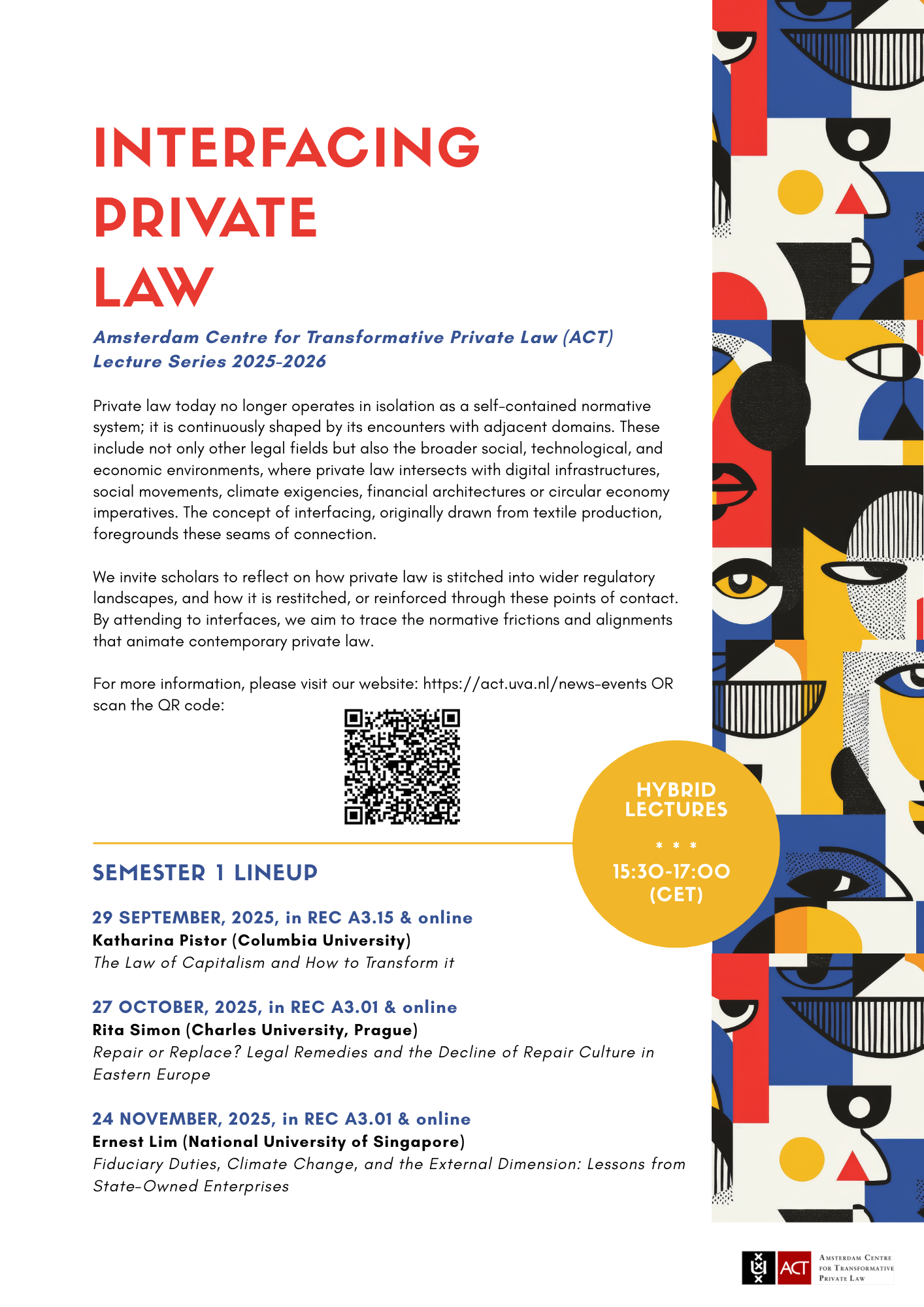
2022/2023 — Ecologies of Private Law
An ecological consciousness is emerging in contemporary law and legal thought. Driven by the subversion of the subject/object distinction, this consciousness signals a renewed and potentially transformative legal paradigm that underscores the inherent interconnectedness of modern society and the blurring boundaries between humans and non-humans. Our Annual Theme for the 2022–2023 Lecture Series examines the place and role of private law within this emerging legal paradigm. Through a sequence of lectures focused on key private law institutions and practices, we seek to identify, understand, and assess how private law interacts with its diverse ecosystems and contributes to shaping socio-economic and political relations among humans or non-humans within these ecosystems, in the context of shifting normative expectations and social needs.
An ecological consciousness is emerging in contemporary law and legal thought. Driven by the subversion of the subject/object distinction, this consciousness signals a renewed and potentially transformative legal paradigm that underscores the inherent interconnectedness of modern society and the blurring boundaries between humans and non-humans. Our Annual Theme for the 2022–2023 Lecture Series examines the place and role of private law within this emerging legal paradigm. Through a sequence of lectures focused on key private law institutions and practices, we seek to identify, understand, and assess how private law interacts with its diverse ecosystems and contributes to shaping socio-economic and political relations among humans or non-humans within these ecosystems, in the context of shifting normative expectations and social needs.
- 26 September 2022 — Anna di Robilant (Boston University): Reinventing Roman Property in Bourgeois Europe
- 31 October 2022 — Pietro Ortolani (Radboud University): Digital Due Process and the Moderation of Lawful (But Harmful) Content on Social Media Platforms
- 28 November 2022 — Anna Beckers (Maastricht University) and Gunther Teubner (Frankfurt University): Human Algorithm Hybrids as (Quasi) Organizations? On the Accountability of Collective Digital Actors
- 12 December 2022 — Beatriz Botero Arcila (Sciences Po, Paris): The Place of Law in the Urban Digital Age
- 23 January 2023 — Stefan Grundmann (Humboldt University Berlin): New Private Law Theory: A Pluralist Approach
- 3 April 2023 — Bram Akkermans: Sustainable Obligations in Property Law
- 15 May 2023 — Rónán Condon (University College Dublin): Network Responsibility. European Tort Law and the Society of Networks
- 12 June 2023 — Margaret Davies (Flinders University): Human and Nonhuman Normativity — What is to be Done?
- 3 July 2023 — Yotam Kaplan (Bar-Ilan University): Climate Change as Unjust Enrichment
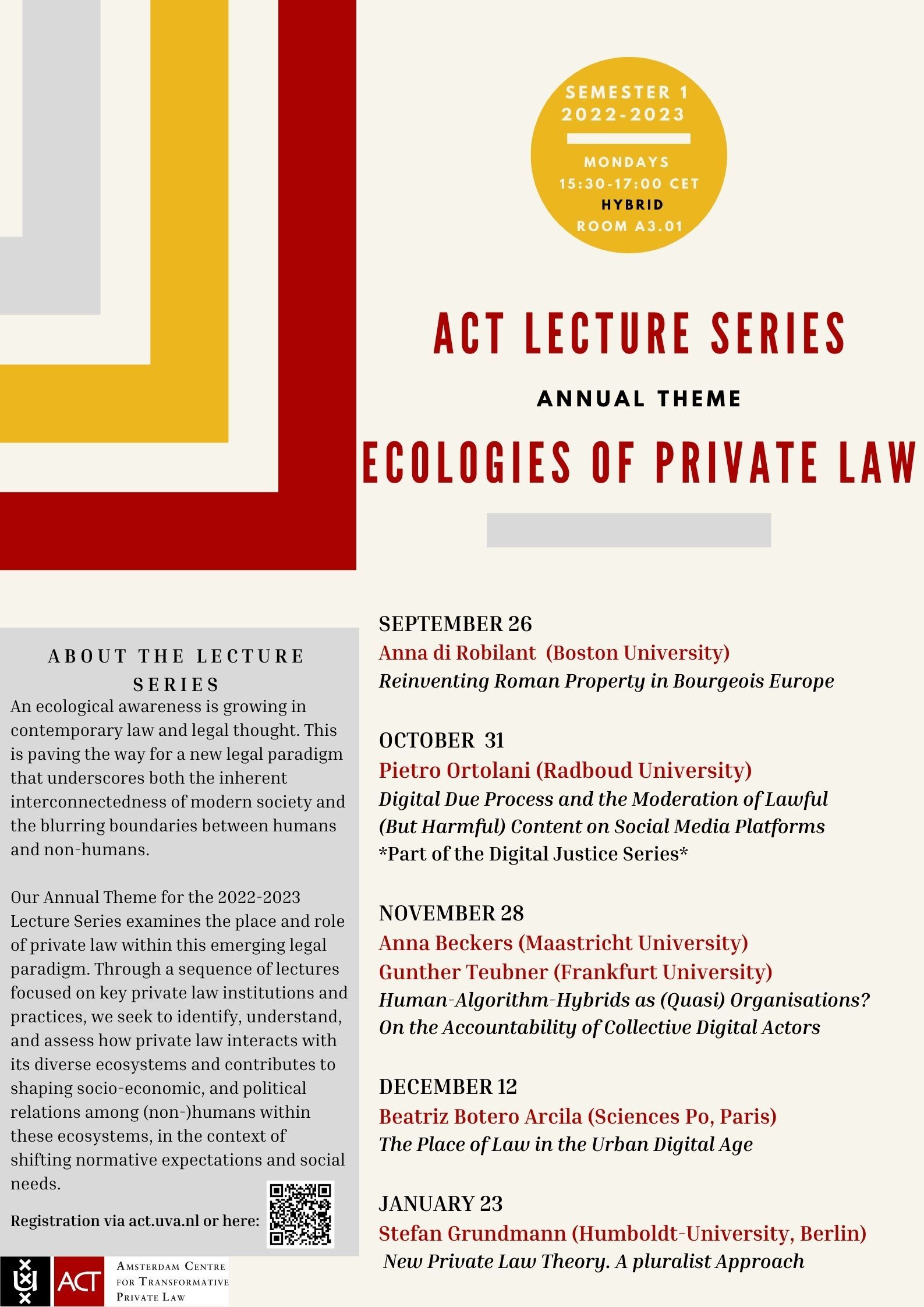
Private law has often been conceived as a timeless, universal project — a project whose appeal stems from its stability. Yet, since the Industrial Revolution, grand socio-economic transformations have drawn private law into the whirl of time. As the legal framework of socio-economic activities, private law shapes the socio-economic, cultural, and ecological environments in which these activities unfold and is at the same time shaped by such realities.
Since the social function of private law is in flux, so too are its basic notions, doctrines and institutions in continuous need of justification. The 2023–2024 ACT Lecture Series asks how intersecting trends such as digitalization, financialization and concerns for sustainability influence private law, and vice versa: What is the future of private law — and what are the agents, concepts, and processes through which its future(s) will be made? Can private law and its doctrinal architecture provide stability in uncertain times, or do its basic pillars need to be revisited? What concrete work might this entail for private law's conception of actors, relations, and remedies, both domestically and in the European and transnational space? (How) does private law conceptualize its own future?
- 13 November 2023 — Gianclaudio Malgieri (Leiden University): Navigating Competing Legal Futures for Digital Law
- 27 November 2023 — Book launch: Chantal Mak & Betul Kas (eds), Civil Courts and the European Polity (OUP, 2023), with Olha Cherednychenko (Groningen University) and Christina Eckes (UvA)
- 22 January 2024 — Leone Niglia (University of Rome — Sapienza): The Structural Transformation of European Private Law: A Critique of Juridical Hermeneutics
- 12 February 2024 — Mavis Maclean (Oxford University): New Directions in Family Justice Policy and Practice in Response to Changing Social Structure
- 11 March 2024 — Poul F. Kjaer (Copenhagen Business School): Transformative Law Beyond the Private and the Public
- 13 May 2024 — Leticia Diez Sánchez (Maastricht University): A Distributional Analysis of EU Law
- 3 June 2024 — Christian Iaione (LUISS / KNAW): Law and Policy of Sustainable Innovation: A Public-Private Law Conundrum
- 17 June 2024 — Tim Bleeker (VU Amsterdam): Modern Risks in Tort Law
- 1 July 2024 — Felipe Jiménez (USC Gould): The Institution of Contract
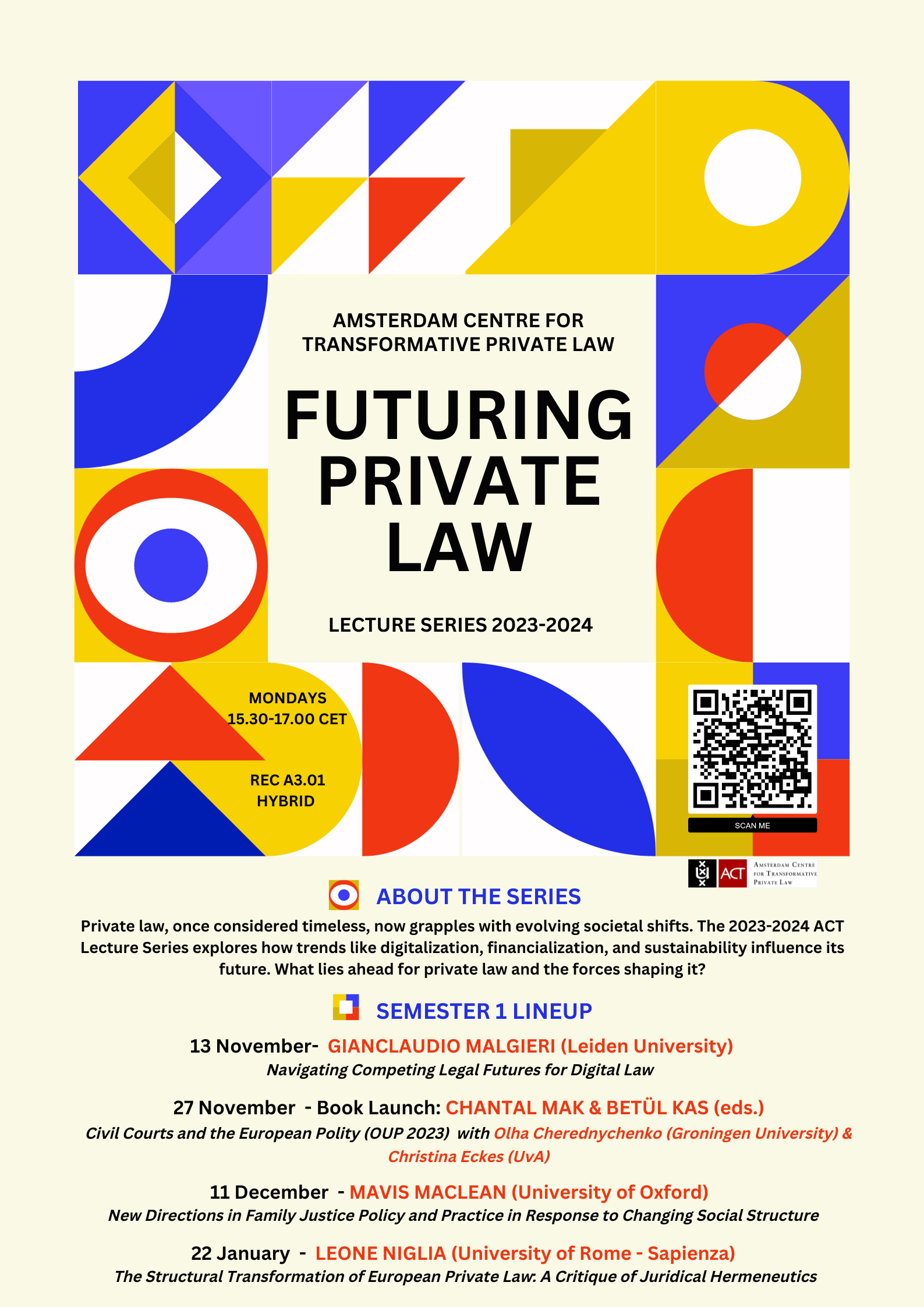
The question of value(s) is high up on the agenda, not least in private law. In times of significant technological, social, ecological, and geopolitical shifts, established conceptions of value and values as an appealing terrain of orientation are being challenged, reasserted, or transformed. The 2024–2025 ACT Lecture Series reflects upon the place and role of private law in these shifting scenarios. It asks whether and how private law norms, doctrines, and institutions are both driving and responding to emerging conflicts among different value(s). What can or should be seen as the value(s) of private law? Is a monistic conception of value tenable in pluralistic societies, and how can pluralistic conceptions of value hold in times of polarisation? Are private law values commensurable? How does private law shape, or how could it shape, prevalent moral-political values or modes of socio-economic valuation across different institutions, such as the family, corporations and other organised economic activity, civil associations, or (non-)commercial relations? And, ultimately: Why private law?
- 17 October 2024 — Günter Frankenberg (Frankfurt University): Book launch: Comparative Law: Introduction to a Critical Practice (Edward Elgar, 2024), with Fernanda Nicola (Washington College of Law)
- 25 November 2024 — Riccardo Fornasari (University of Bologna): The Legal Form of Climate Litigation
- 9 December 2024 — Robert Wai (Osgoode Hall Law School): Liberal Values and Transnational Private Law
- 27 January 2025 — Sofie Cools (Radboud University): Agency Conflicts in Social Enterprises
- 24 February 2025 — Roy Kreitner (Tel Aviv University): GVCs and the Limitations of Contract Theory
- 28 April 2025 — Thomas Meysen (SOCLES, Heidelberg): What is Family?
- 12 May 2025 — Riccardo Fornasari (University of Paris Dauphine PSL): The Legal Form of Climate Litigation
- 26 May 2025 — Konstanze von Schütz (McGill University, Montreal): Public Property(s)
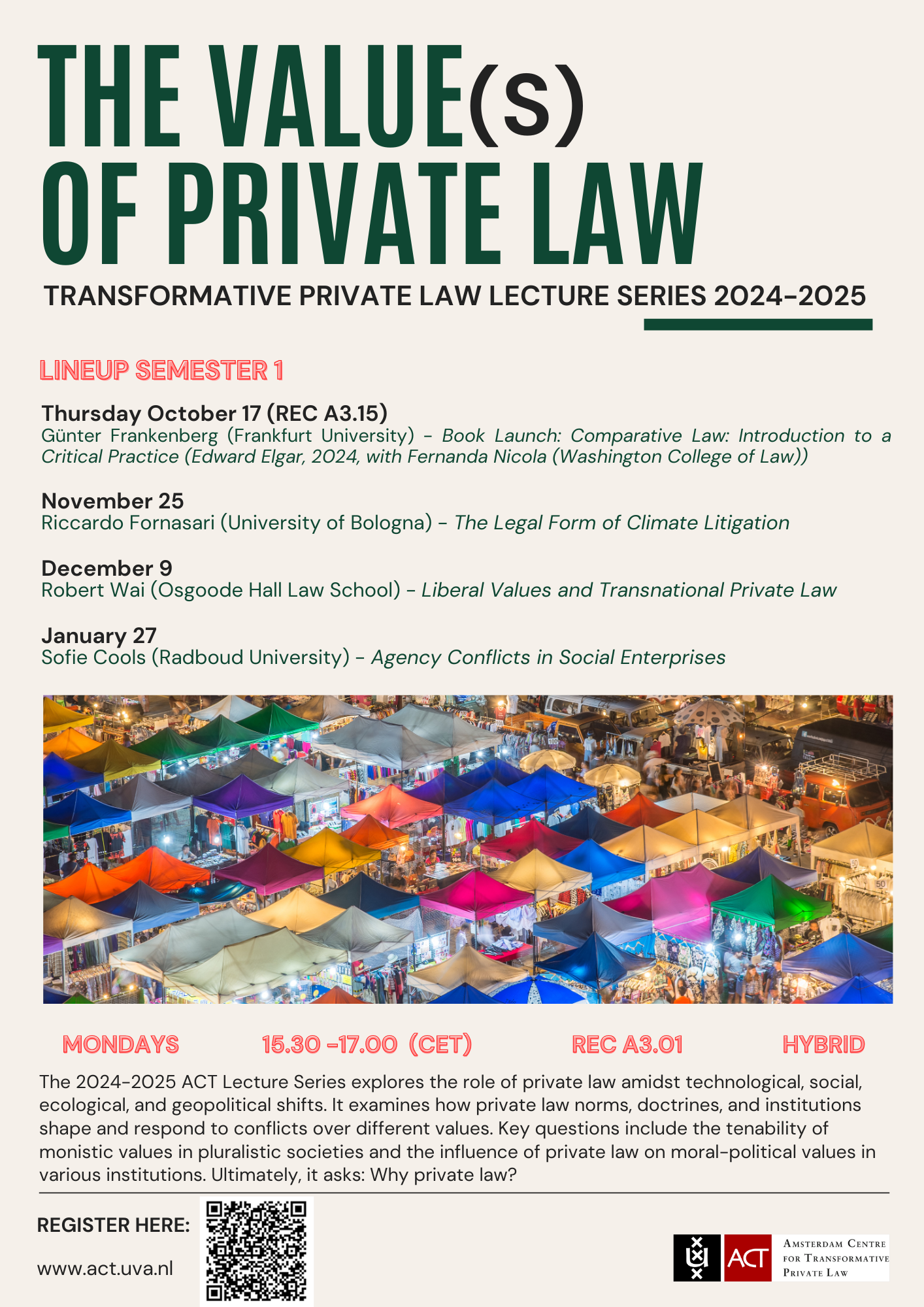
This lecture series explores the evolving frontiers of private law through the lens of interfacing — as both a metaphor and a method. Private law today no longer operates in isolation as a self-contained normative system; it is continuously shaped by its encounters with adjacent domains. These include not only other legal fields but also the broader social, technological, and economic environments, where private law intersects with digital infrastructures, social movements, climate exigencies, financial architectures or circular economy imperatives. The concept of interfacing, originally drawn from textile production where an 'interface' denotes the inner layer used to join and give form to separate fabrics, foregrounds these seams of connection. It invites scholars to reflect on how private law is stitched into wider regulatory landscapes, and how it is restitched, destabilized, or reinforced through these points of contact. By attending to interfaces — such as between contract and code, property and sustainability, tort and platform accountability — we aim to trace the normative frictions and alignments that animate contemporary private law.
In embracing this perspective, the series positions private law as a site of active mediation, responsive to transformations in technology, politics, and society. At the same time, it reflects critically on private law's own texture, its internal vocabularies, traditions, and genealogies: how do the pasts of private law shape its present and possible futures, which concepts remain fit for purpose, and which require retooling? Interfacing Private Law is thus both a descriptive and normative endeavour — tracing how private law is made and remade in practice, and questioning what role it ought to play in governing the rapidly shifting realities of the 21st century.
- 29 September 2025 — Katharina Pistor (Columbia Law School): The Law of Capitalism and How to Transform It
- 27 October 2025 — Rita Simon (Charles University, Prague): Repair or Replace? Legal Remedies and the Decline of Repair Culture in Eastern Europe
- 24 November 2025 — Ernest Lim (NUS Law): Fiduciary Duties, Climate Change, and the External Dimension: Lessons from State-Owned Enterprises
- 30 March 2026 — Martijn Hesselink (EUI): Prefigurative EU Law
- 20 April 2026 — Britta van Beers (VU Amsterdam): Humanhood. The Humanising Functions of Legal Personhood in a Posthuman Age
- 11 May 2026 — Julia Dehm (La Trobe): Climate Injustice, Racial Capitalism, and the Contradictions of Property
- 18 May 2026 — Elbert de Jong (Utrecht University): Rethinking Civil Liability Law Through Climate Change Litigation
- 15 June 2026 — Bronwen Morgan (UNSW Law School): Legal Infrastructure for Regenerative Economies
- 29 June 2026 — Ralf Michaels (MPI Hamburg): Equality Through Private Law?